
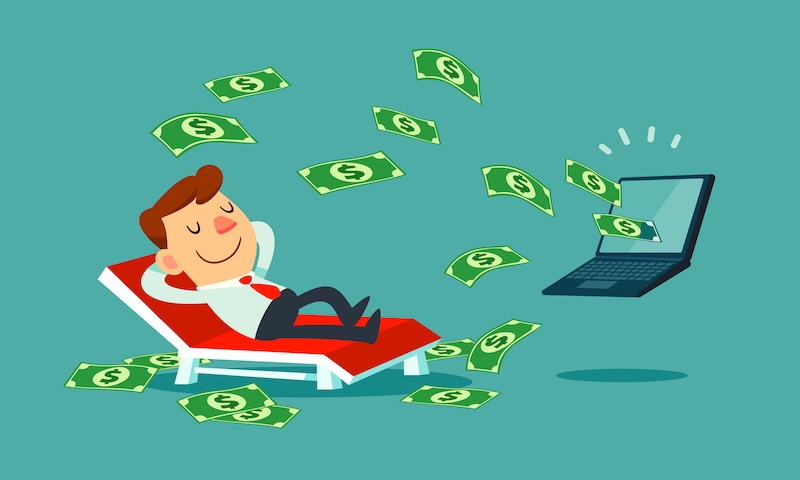
Everyone has heard the phrase “make money while you sleep.” It sounds dreamy — and in the way it is usually sold online, it is too good to be true. But the underlying concept is completely real. The keyword, though, is built. Nothing generates money on its own without upfront investment of time, capital, or both.
Passive income is formally defined by the IRS as income requiring minimal ongoing effort — typically from a business in which you do not materially participate, or from investments generating returns on their own. In 2026, more Americans than ever are chasing it.
Why everyone is chasing this right now
The financial pressure behind the trend is real. Wages rose 18% from 2020 to 2024 — but inflation rose 21% over the same period. Most workers have less purchasing power today than they did five years ago. The share of employees holding more than one job hit 5.7% in late 2025, the highest level of the new millennium. People are not pursuing passive income as a luxury anymore. For many families, it is a necessity.
The big categories worth knowing
Dividend stocks & index funds
The entry point for most. The S&P 500 has returned ~10% annually over 50 years. Reliable, but you need meaningful capital for dividends to move the needle in daily life.
Rental real estate
The classic play. Nearly 40% of homeowners are considering renting part of their homes. Short-term rentals offer strong returns, but active management — or a property manager — is almost always required.
Franchises & semi-absentee ownership
You buy a proven system rather than build one. Semi-absentee owners typically spend 5–10 hours a week on oversight. Passive income is a long-term outcome here, not a guarantee from day one.
Buying an existing business
Underrated option. A stake in a local café, laundromat, or agency can be largely passive — provided you do rigorous due diligence and the business can run without you or the previous owner.
What separates average earners from real ones
Most people who earn passive income earn a small supplement — that $350 a month. The entrepreneurs who actually replace their active income share a few things in common.
- They invest in assets with management infrastructure built in — systems and people, not themselves showing up every day.
- They pick models with recurring, recession-resistant demand and operational simplicity that does not depend on their personal skills.
- They are patient with capital. Passive ownership involves higher upfront costs and slower ROI. The investors who succeed bring reserves and a long-term perspective.
The mindset shift that changes everything
The biggest mistake most people make is thinking too small or expecting results too fast. You are not looking for a shortcut. You are building an asset — and assets take time to mature.
The approach that works: start with your strengths, master one or two income streams before adding more, and grow step by step. Pick a vehicle that fits your capital, your risk tolerance, and how hands-on you realistically want to be. Then go deep on it instead of spreading yourself thin.
The goal was never to work forever. It was to build something that works for you. That is what passive income, done right, actually looks like.
Article contributed by
Katie Melissa – Entrepreneur
